

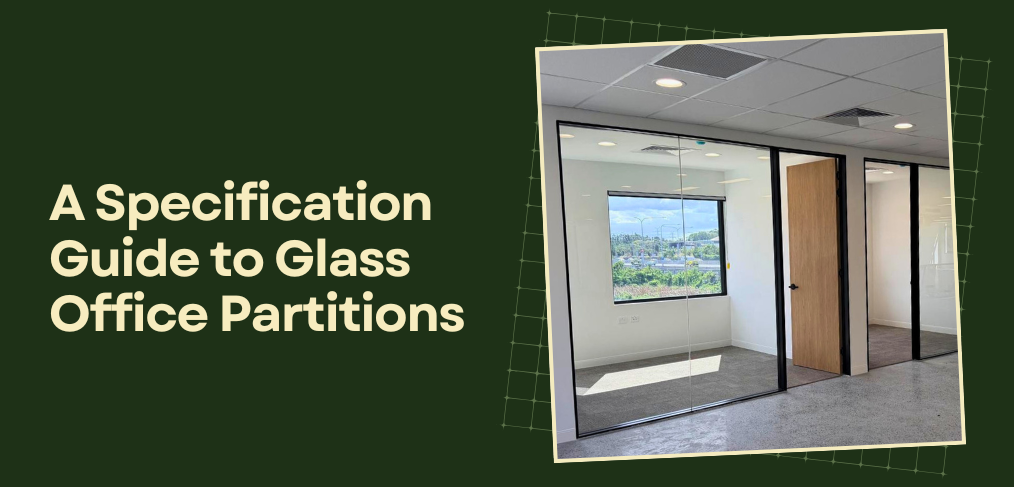
With more than two decades of supplying aluminium partition systems into commercial fit outs across Australia, Bris Aluminium has watched the role of glass in office designs shift from premium feature to default expectation.
Open-plan offices created a brief that plasterboard couldn’t quite answer. Tenants wanted daylight reaching all aspects of the floor plan. Designers wanted the cellular spaces, the meeting rooms and executive offices, to feel connected to the larger workspace rather than walled off from it. Glass solved both, and once the specification language was in place, once the framing systems were refined and the installation became predictable, glass started being the standard.
For architects working on commercial fit outs today, the question isn’t whether to use glass office partitions. It’s how to specify them well, where the limitations sit, and which framing system suits the project.
This guide covers all three.
The benefits of glass in a commercial fit out
There’s a reason almost every commercial brief written in the last decade includes some version of the same buzz words: open feel, bright, spacious, and connected.
Plasterboard can’t deliver any of those. A plasterboard wall divides a floor plan and terminates the light. It creates a boundary the eye can’t see past, which is fine in some applications and exactly what is wrong in most modern offices. Walk into a tenancy where the meeting rooms are plasterboard and you feel the difference immediately. The space contracts; the corridor reads as a corridor rather than as part of the open plan. The cellular offices feel like rooms you’ve been sent to, not rooms you’re working in.
Glass changes the equation entirely. A glazed partition reads as a boundary rather than a barrier. Daylight from the perimeter carries across the floor plate rather than stopping at the first cellular wall. The manager in the enclosed office retains presence on the floor. The meeting room is still a room, but the team outside it stays visually connected to what’s happening inside.
The compounding effect on smaller floor plans is significant. A tenancy that would feel cramped in plasterboard feels generous in glass. The square metreage hasn’t changed, but the experience of being in it has. For tenants negotiating leases against floor area, and for designers working within tight commercial footprints, that visual gain matters.
There’s also a code dimension worth naming. NCC requirements for borrowed light mean natural light must reach certain occupied spaces, and glazed partitions are frequently the most practical way of satisfying that obligation while still delivering the enclosure the program calls for. A well-specified glass wall does compliance work and design work at the same time, which is part of why it’s become the default specification across so many project types.
Acoustic performance
Glass performs below plasterboard acoustically. A standard plasterboard partition delivers better sound separation than a single glazed system of equivalent dimensions, and the gap doesn’t fully close even with double glazing. If the client is comparing the two on acoustic performance alone, plasterboard wins.
For most commercial office fit outs, the comparison isn’t the right one to be having. The brief isn’t asking for plasterboard-grade acoustic separation. It’s asking for visual openness and a workspace that feels modern, with enough acoustic separation to support normal speech privacy in meeting rooms and standard cellular offices. Glass can deliver that. The acoustic performance is more than adequate for the actual demands of the space, and the visual benefit far outweighs the marginal acoustic trade-off.
Most modern offices don’t need the level of acoustic privacy plasterboard delivers. Open collaboration zones, breakout spaces, and meeting rooms with standard speech privacy all sit comfortably within the performance range of a well-specified glazed system. The cellular office where someone takes phone calls and has occasional one-to-one conversations doesn’t need acoustic isolation. It needs visual enclosure and enough separation that the conversation doesn’t carry into the open plan.
Where the conversation changes is in fit outs where both visual privacy and acoustic privacy are non-negotiable. The clearest example is medical work. Glass partitions, by definition, can’t deliver visual privacy in their standard configuration. Frosted or switchable privacy glass solves the visual side but adds cost and complexity, and even then the acoustic performance still needs careful attention. For medical work, the specification conversation looks different from the start. It needs to address visual and acoustic privacy together, with the right system combinations and the right glazing choices.
The same systems handle glass and plasterboard
One of the practical realities that architects and builders working with the Bris Aluminium range come to appreciate is that the framing stays consistent across glazed and plasterboard infills within the same system family.
A meeting room with three glazed walls and one solid wall can be specified as a single system rather than two. A corridor wall that’s solid for the first three metres and glazed for the next two doesn’t need a transition detail or a change in framing depth. The head track, the base track, the vertical stud spacing all remain consistent. The visual line carries cleanly across both. The installation runs as a single sequence rather than two parallel ones, which collapses the coordination overhead between trades.
The system most commonly specified across mixed glass and plasterboard runs in commercial fit outs is the Supreme. It’s available in 64mm, 76mm, and 92mm profiles, accommodates both glazing and plasterboard infills, and accepts door thicknesses from 35mm to 45mm within the same framing. It’s the workhorse of the range and the system most architects reach for first.
For projects where visual consistency between glazed and solid sections is more than a nice-to-have, the new Australis 35mm system, arriving in July 2026, is purpose-built for it. The 35mm sightline carries consistently across glazed sections, plasterboard infills, door jambs, windows, cavity sliders, and transoms. Where two elements of the system meet, the join reads as a single clean line rather than a chunky double-width connection that breaks the visual flow. For premium commercial fit outs where the framing is part of the visible architecture rather than a background system, the Australis lifts the finish into the high-end category without requiring custom fabrication.
The Econo, Slimline, Light Duty Shopfront, and Adjustable systems also accommodate glazed and plasterboard configurations, each suited to a different project type. The full breakdown of which system fits which application is covered in our aluminium partition system guide.
Specifying glass office partitions with Bris Aluminium
The systems behind the glass walls of commercial fit outs across Australia have been refined over more than twenty years of work with architects, builders, and fitout specialists. All Bris Aluminium systems are ISO 9001 certified, manufactured locally, and supplied pre-fabricated in kit form with detailed design drawings published online for every product in the range.
For glass office partitions specifically, the specification decisions that matter aren’t unique to the glazing. They’re decisions about which system handles the mix of glazed and solid partitions across the floor plan, which profile suits the visual brief, and what the acoustic requirements actually are once the open-plan and cellular spaces are mapped out properly.
Send the team a floorplan, the level of acoustic separation the brief calls for, and a finish direction. Contact our sales team today.
