

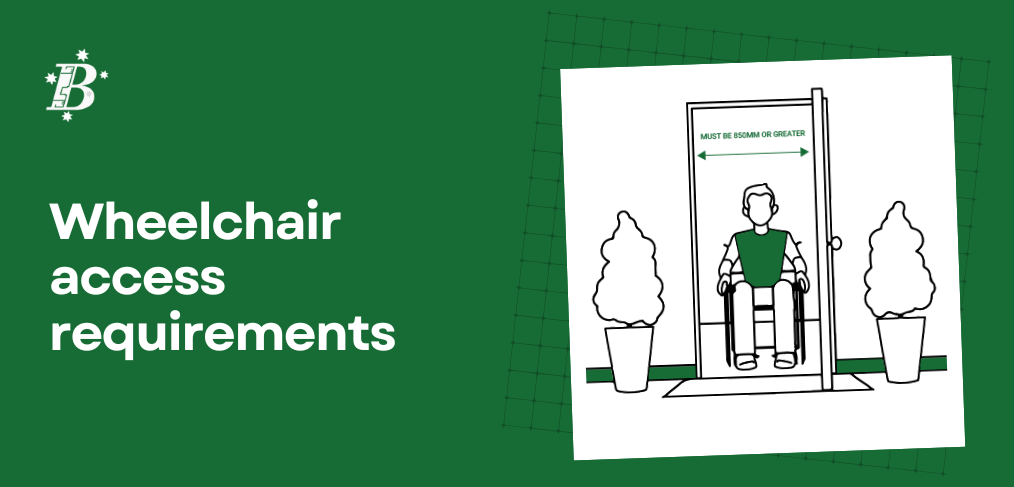
When designing or upgrading a commercial building in Australia, wheelchair door width is a critical compliance and usability consideration. Doorways form part of the accessible path of travel, and getting their width, hardware and operation right is essential for meeting Australian Standards and creating genuinely inclusive spaces.
Wheelchair access requirements are clearly defined under Australian building regulations. However, many projects still fall short due to misunderstandings around clear opening widths, circulation space, door hardware and thresholds. What looks compliant on paper does not always translate to real-world usability.
This guide explains everything you need to know about wheelchair door width in Australia, including minimum requirements, common compliance pitfalls and practical design solutions that work in commercial environments.
With more than 20 years of experience supplying premium aluminium partitioning and door systems, Bris Aluminium helps architects, builders and designers deliver accessible spaces that meet regulations without compromising durability, performance or aesthetics.
Wheelchair access requirements in Australia
Wheelchair door width requirements in Australia are governed by several interconnected regulations, including the Building Code of Australia, AS 1428.1 Design for Access and Mobility, the Disability (Access to Premises – Buildings) Standards 2010 and the Disability Discrimination Act 1992 (Cth). Together, these standards ensure that people using wheelchairs or mobility aids can move independently through buildings via continuous accessible paths of travel.
Doors play a central role in this pathway. They must be easy to approach, easy to operate and easy to pass through without requiring excessive force or awkward manoeuvring. When any one of these elements is overlooked, accessibility quickly breaks down.
Minimum wheelchair door width Australia
The most critical measurement for wheelchair access is the clear opening width of a doorway. This is not the size of the door leaf itself, but the usable opening available when the door is fully open.
Clear opening width is measured from the face of the open door to the opposite door stop or frame. This measurement reflects the actual space available for a wheelchair to pass through safely.
Under Australian Standards, the minimum clear opening required for wheelchair access is 850mm. This width must be continuous and unobstructed. Any intrusion into this space can result in non-compliance.
Doorways often fail to meet wheelchair door width requirements due to elements such as handles, hinges, architraves, skirting boards or doorstops projecting into the opening. Even when a door appears wide enough, these details can reduce the usable width below the required minimum. For this reason, relying on nominal door sizes alone is risky. The clear opening must always be measured and verified.
Door circulation space for wheelchair access
Clear width alone does not guarantee accessibility. Adequate circulation space around the doorway is equally important.
A wheelchair user needs enough space to approach the door, reach and operate the handle, open the door without being struck by it and then be able to move through the opening smoothly. If circulation space is inadequate, even a compliant door width can become difficult or unsafe to use.
Hinged doors and circulation requirements
This issue is particularly relevant for hinged doors. Because the door leaf swings into the space, additional clearance is required to prevent the door from colliding with the user during operation. In tighter commercial layouts, this can be challenging to accommodate.
Sliding doors and circulation advantages
Sliding doors eliminate this problem by removing the swing arc entirely. Because the door moves laterally, circulation space requirements are reduced and movement through the doorway becomes more predictable. This makes sliding doors, particularly our cavity sliders, a practical solution for achieving wheelchair door width compliance in space-constrained environments.
Choosing the right door type for wheelchair door width compliance
Hinged doors can meet wheelchair access requirements when circulation space is carefully designed, opening forces are minimised and hardware is correctly positioned. However, they often consume valuable floor space and can complicate compliance in corridors, offices and amenities.
Sliding doors are often easier to work with from an accessibility perspective. Because the full opening width remains usable and there is no door swing, maintaining the required wheelchair door width becomes simpler. Circulation space requirements are also reduced, which is particularly valuable in commercial fit outs.
Bris Aluminium’s cavity door slider systems are designed with accessibility in mind. With a standard one-metre-wide carcass and the ability to accommodate doors up to 1500mm wide, these systems provide generous clear openings that support both compliance and ease of use.
Best door materials for wheelchair access
Why aluminium is ideal for wheelchair access doors
Material selection has a significant impact on how accessible a door is in everyday use. Doors must be durable enough to withstand commercial traffic while remaining easy to operate for users with limited strength or mobility.
Aluminium is particularly well suited to wheelchair-accessible door applications. It offers an excellent balance of strength and lightweight operation, meaning doors require less force to open and close. This directly supports accessibility requirements by reducing physical effort for wheelchair users.
In addition, aluminium resists warping, swelling and degradation over time. In busy commercial environments, this durability helps ensure doors remain compliant long after installation, rather than gradually becoming harder to operate.
Door opening force and closers
Australian Standards require doors to be operable without excessive force. This makes door closers an important part of accessible design.
Cam action door closers are widely regarded as the best option for wheelchair-accessible doors. They reduce the force required to open the door, provide controlled closing and prevent slamming. When paired with lightweight aluminium door systems, they significantly improve comfort and usability.
Accessible door hardware
Door hardware is one of the most commonly overlooked aspects of wheelchair door width compliance.
Handles and locks should be positioned between 900mm and 1000mm above finished floor level, so they are within comfortable reach for wheelchair users. Placement outside this range can make doors difficult or impossible to operate independently.
The type of handle is just as important as its location. Accessible door handles should be operable with one hand and should not require tight grasping, pinching or twisting. Lever handles, push plates and pull handles are generally preferred, while round knobs should be avoided wherever possible.
Adequate clearance around the handle is also essential. There must be at least 60mm between the handle and the edge of the clear opening to allow enough space for a user’s hand to grip and operate the handle comfortably.
Bris Aluminium offers a wide range of high quality Hafele door hardware designed for wheelchair-accessible environments.
Doorway thresholds for wheelchair access compliance
Thresholds can present a significant barrier to wheelchair users if not carefully designed.
Best practice is to avoid raised thresholds altogether and use weather-stripping or flush floor finishes instead. This creates a smooth transition that is easy for wheels to navigate.
Where thresholds are unavoidable, they should not exceed 20mm in height and should have gentle transitions rather than abrupt level changes. Sliding doors with recessed runners are particularly effective, as they create a flush threshold that supports easy movement.
Designing beyond minimum wheelchair door width requirements
Meeting minimum door standards is essential, but thoughtful design goes further.
Add glazing or vision panels
Windows within doors allow users to see what’s on the other side, reducing collision risk and improving confidence.
Allow extra space where possible
Exceeding minimum circulation requirements improves comfort and ease of movement, especially in high-use areas.
Choose wider door systems
While 850mm is the minimum wheelchair door width in Australia, wider openings are often more practical and inclusive.
Wheelchair access door solutions with Bris Aluminium
Designing compliant wheelchair door widths requires more than reading the standards. It requires understanding how doors, hardware, circulation space and materials work together in real-world environments.
Bris Aluminium supports commercial projects by interpreting accessibility standards correctly and supplying aluminium door and partitioning systems that meet compliance requirements while remaining practical, durable, and visually refined.
Our ISO 9001-certified systems are proven across office, healthcare, education and commercial fit-outs Australia-wide. If you need guidance on wheelchair door width, door systems or accessible hardware, our team is here to help.
Contact Bris Aluminium for expert advice on wheelchair-accessible aluminium door solutions.
Wheelchair door measurement requirements for quick reference
For designers and builders needing a fast summary, the key requirements are:
- Minimum clear opening width: 850mm (Measured from the face of the open door to the door stop or frame)
- Clear opening must be: Unobstructed and continuous, with no handles, hinges, architraves, skirting boards or doorstops intruding into the 850mm width
- Circulation space: Required at every doorway to allow approach, handle operation, door opening, and passage through the opening. (Dimensions vary depending on door type and swing direction under AS 1428.1)
- Handle and lock height: Between 900mm and 1000mm above finished floor level
- Handle clearance from clear opening: Minimum 60mm between the door handle and the edge of the clear opening
- Threshold height: Maximum 20mm where thresholds cannot be avoided